4.4.1 Science Programme during the Phase Diversity Calibration Campaign
The Phase Diversity Calibration Campaign (PDCC) was carried out during the early operations of Euclid to characterise the optical wavefront of the telescope and its dependence on the thermal state of the spacecraft. The resulting measurements provide the basis for modelling variations of the Point Spread Function (PSF) of the VIS instrument under different observing conditions. The campaign started following completion of the Performance Verification phase on 3 December 2023 and continued until 11 February 2024, shortly before routine execution of the Euclid Reference Survey Definition began on 14 February 2024. The PDCC lasted approximately 70 days and represents an important component of the early-mission observations included in DR1.
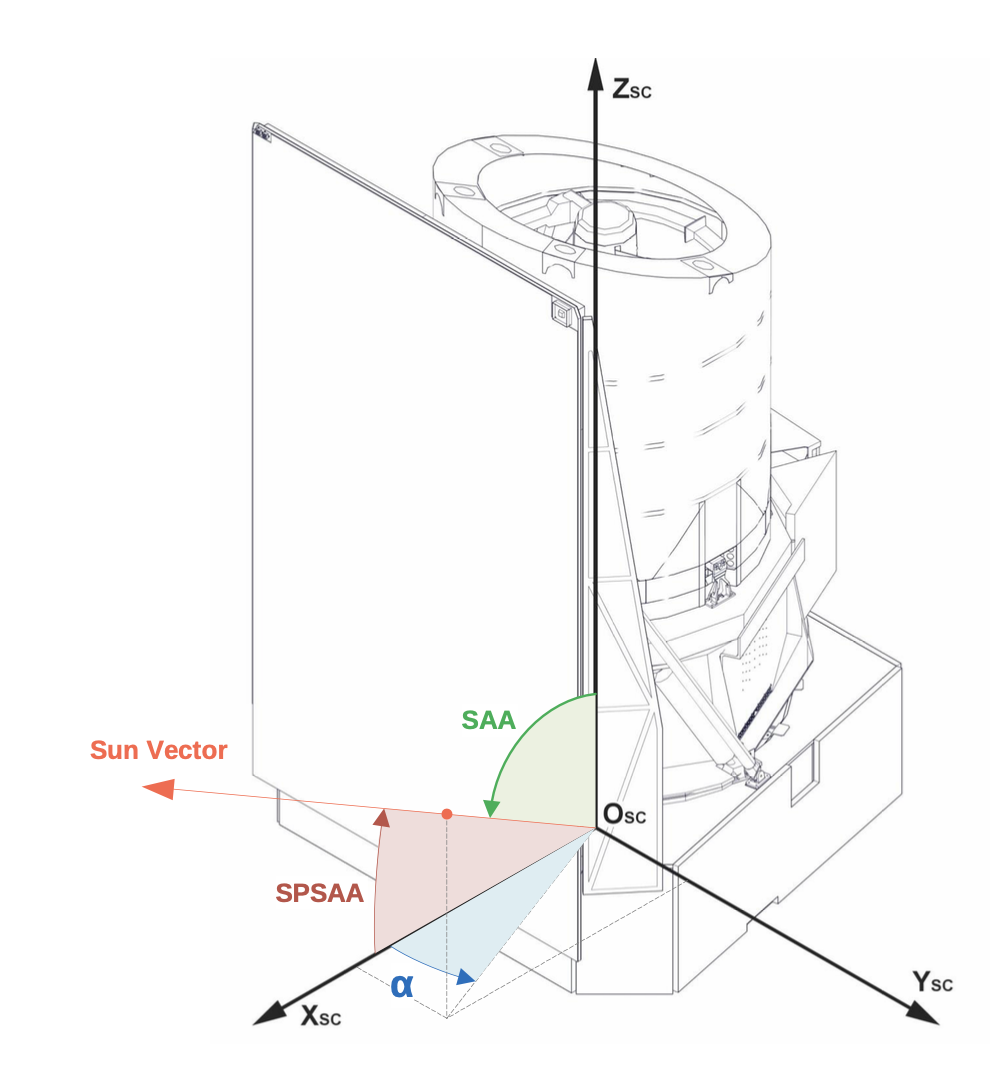
The shape of the VIS PSF depends, among other factors, on optical aberrations introduced by the telescope. These aberrations vary with the thermo-elastic state of the payload module. As Euclid observes different regions of the sky, changes in spacecraft orientation relative to the Sun produce small variations in solar illumination and consequently in the thermal state, position, and shape of telescope optical elements. The spacecraft orientation relative to the Sun is characterised principally by the Solar Aspect Angle (SAA) and alpha angle (AA) (see figure 4.1). The main objective of the PDCC was therefore to measure the telescope wavefront for a representative set of thermal states associated with different combinations of SAA and AA. The resulting wavefront-error measurements provide a basis set of optical models that can subsequently be fitted to survey data.
The optical wavefront cannot, in general, be uniquely reconstructed from images of in-focus point sources alone. Euclid therefore used the phase-diversity technique, in which stellar fields were observed both in focus and with a known amount of defocus. The defocused observations were produced by displacing the telescope secondary mirror (M2) along the optical axis. Comparison of the in-focus and defocused stellar images allows the wavefront error to be reconstructed and expressed in terms of optical aberrations.
4.4.1.1 PDCC implementation and science observations
The PDCC consisted of a series of calibration runs sampling different, fixed thermal states. Seven runs, designated PDC-2 to PDC-8, were executed during the campaign, following an initial PDC-1 test performed during Performance Verification. Four runs included out-of-focus phase-diversity sequences, lasting approximately 3.2 days each, while three used shorter in-focus sequences of approximately 1.25 days. The required thermal stability was better than 10 mK for out-of-focus observations and 60 mK for in-focus observations, compared with payload-module temperature variations of several hundred millikelvin during typical survey operations.
Before each calibration run, the telescope therefore had to reach a sufficiently stable thermal state. The early campaign observations confirmed that a thermalisation period of approximately seven days was appropriate. In total, these periods accounted for approximately 50 days, or 70% of the duration of the PDCC. Because these intervals represented a substantial amount of observing time, dedicated science programmes were developed to make scientifically productive use of the telescope while maintaining the required thermal conditions.
During each thermalisation period the spacecraft maintained approximately the SAA and AA required for the subsequent wavefront calibration. Euclid could nevertheless change its pointing by rotating around the Sun direction, allowing accessible regions of the sky to be observed without significantly altering the thermal state of the payload. The resulting science programme comprised three components: the Euclid Medium-Deep Survey (EMDS), the Euclid Ecliptic Survey (EES) targeting Solar System Objects, and the Independent Legacy Scientists (ILS) programme. Together they produced seven distinct PDCC science fields, five belonging to the EMDS and one each to the ILS and EES programmes.
The campaign was organised operationally in three scheduling batches:
-
•
Batch 1: 3 to 23 December 2023
-
•
Batch 2: 23 December 2023 to 25 January 2024
-
•
Batch 3: 25 January to 11 February 2024
The general sequence associated with a thermal state consisted of science observations during thermalisation, followed by the dedicated wavefront calibration observations, additional calibration activities where required, and finally the transition to the next thermal state.
At the beginning of the campaign, seven thermal states were planned for wavefront characterisation. Calibration observations suitable for constructing the wavefront-error basis were ultimately obtained for six of these states. Initial analysis demonstrated successful wavefront retrieval from the phase-diversity observations, with independent datasets yielding wavefront solutions reproducible to better than approximately 2.7 nm rms. This value represents the reproducibility of the retrieved solution rather than its absolute accuracy.
The campaign also provided new information on the in-flight thermal behaviour of Euclid. In particular, the thermal state of the payload was found to depend more strongly on SAA than had been anticipated from pre-flight modelling. Instrument operation itself was also found to influence the thermal state through heat dissipation. During PDC-2, for example, switching off NISP between the science observations and the subsequent VIS calibration sequence produced an approximately 60 mK decrease in the payload-module baseplate temperature.
To avoid such disturbances during the more thermally demanding phase-diversity sequences, NISP was subsequently disabled throughout the thermalisation periods preceding the out-of-focus calibration runs, including the accompanying in-focus observations. Full ROS observations using both VIS and NISP were retained for the thermalisation periods preceding the less stringent in-focus-only calibration runs. This operational change had a direct impact on the science dataset: only two of the five EMDS fields contain NISP observations, while the remaining three contain VIS observations only.
The PDCC science observations constitute a substantial early-mission astronomical dataset. The three programmes provide complementary survey characteristics: the ILS programme obtained relatively wide, shallow VIS+NISP coverage; the EMDS exploited the PDCC geometry to obtain strongly overlapping observations reaching approximately four to five times the nominal Wide Survey exposure depth; and the EES provided densely sampled VIS+NISP observations close to the ecliptic plane. These datasets are described separately in the following sections, and more information on PDCC planning can be found in Euclid Data Release 1 (DR1). The Euclid surveys at DR1
The PDCC therefore served two complementary purposes. It established an early-mission observational basis for characterising the telescope wavefront and modelling variations of the VIS PSF with thermal state, while simultaneously transforming the otherwise largely unavailable thermal-stabilisation time into scientifically useful observations. The campaign also provided direct in-flight information on the relationship between spacecraft attitude, instrument operation, thermal behaviour, and optical performance.
4.4.1.2 PDCC science programme observing constraints
TBI
4.4.1.3 Factors affecting science data quality
Although the SAA/AA configurations selected for wavefront retrieval were within the spacecraft flight envelope and sampled thermal states that also occur naturally during the nominal survey, the sequencing of substantially different thermal states during the PDCC produced larger and more abrupt thermal transitions than those normally encountered during routine Wide Survey operations. During the nominal survey, variations in solar angles are deliberately minimised when scheduling consecutive observations. The PDCC, by contrast, required transitions between predefined and sometimes substantially different thermal states.
As a consequence, the telescope optical state, and therefore the VIS PSF, could evolve more rapidly during the early part of a thermalisation period than under typical Wide Survey conditions. These variations are intrinsic to the PDCC observing strategy and may therefore be present in the associated science observations. The expected effect on overall image quality and photometric performance is small, but it has not been characterised with the same precision as for nominal survey observations. Users requiring particularly accurate PSF characterisation should therefore take the thermal history of individual PDCC observations into account.
A second effect relevant to early-mission PDCC observations is water-ice contamination of the telescope optics. Thin layers of water ice accumulated on cold optical surfaces as a result of spacecraft outgassing during the first months of the mission. The contamination produced a time-dependent reduction in optical throughput, particularly affecting VIS. After the PDCC, selective heating of optical elements was used to remove the contamination, with the first dedicated decontamination campaign taking place in March 2024.
When comparing PDCC observations obtained at different epochs, or with survey observations obtained after decontamination, this evolving throughput should therefore be taken into account. The ice-contamination effect is distinct from the thermo-elastic PSF variations that the PDCC was designed to characterise, although both effects were present during the early-mission period.