15.3.6 Notebook to compute the object specific exposure time
Because of the dithering and the observing strategy, the total exposure time and the number of single-epoch frames (“layers”) contributing to the image vary from position to position within a tile. The notebook33 3 https://github.com/esa/euclid-contributed-jupyter-notebooks computes, for every object in a MER final catalog of a tile, the exposure time and the number of layers at the object position. It does so for the VIS, NIR-Y, NIR-J and NIR-H bands. The results are written as new columns of an extended copy of the catalog. Optionally, the exposure time is also written as a FITS image in the same pixel grid and WCS as the corresponding band mosaic (Fig. 15.5).
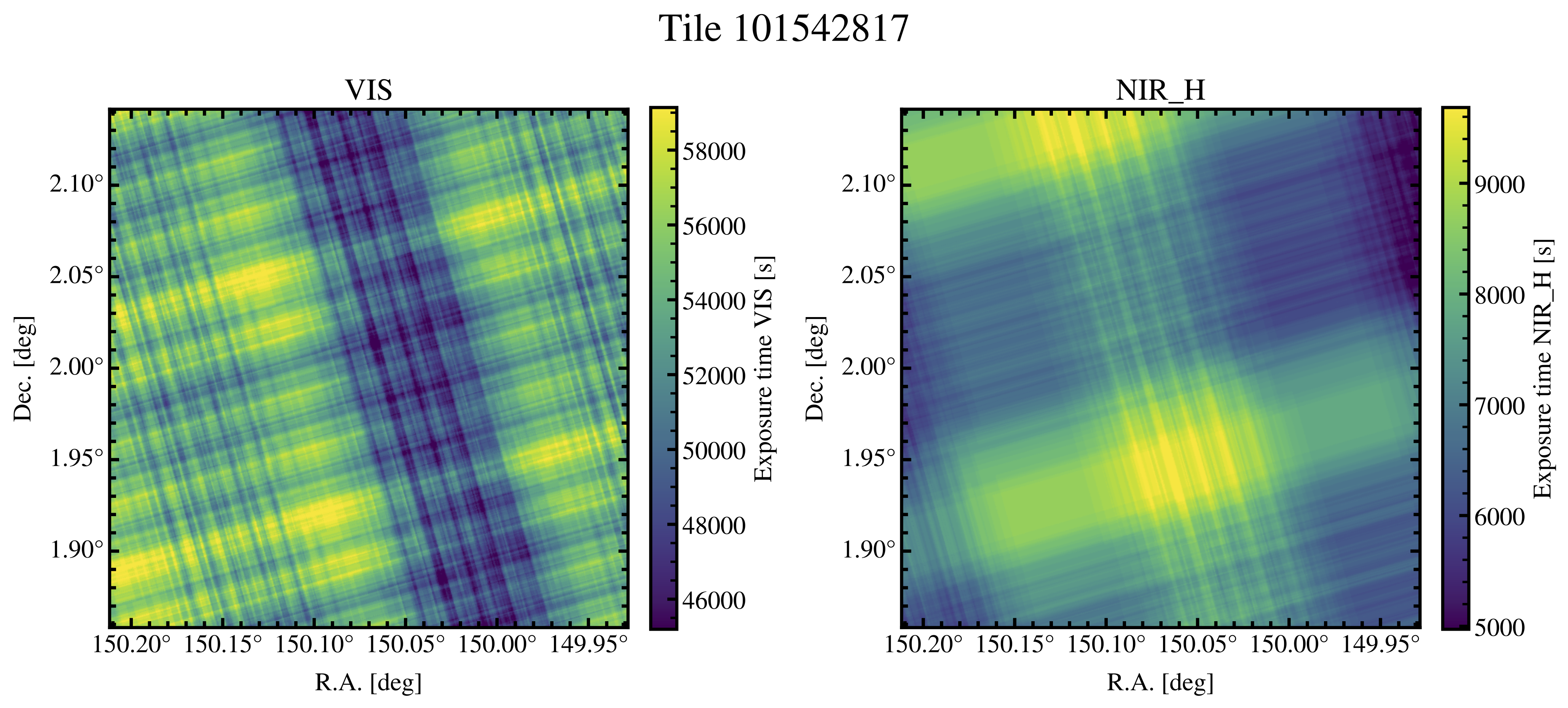
15.3.6.0.1 Inputs.
-
•
One or several tile IDs (comma-separated list).
-
•
One band, or all bands (band = None, which selects VIS, NIR_Y, NIR_J, NIR_H).
-
•
Processing parameters: the HEALPix order (healpix_order, default 17, i.e. about ), the row-chunk size used for image creation (chunk_height), and a switch to also write exposure-time maps (write_exptime_maps).
For each tile and band the notebook reads from the Euclid DR1 data space: the background-subtracted mosaic (BGSUB-MOSAIC), the LAYERING file stored next to it, and the MER final catalog.
15.3.6.0.2 Outputs.
-
•
A HEALPix coverage table per tile and band
(mosaicing_layer_mapping_<tile>_<band>.fits). -
•
The extended catalog _EXPTIME.fits with the columns EXPTIME_<band> and NLAYER_<band> added for each band (¡band¿ is VIS, Y, J or H).
-
•
Optionally, one exposure-time image per band.
-
•
Diagnostic plots of the exposure time and number of layers on the sky.
15.3.6.0.3 Limitations.
-
•
The resolution is set by the HEALPix order. At order 17 the pixel size is about . Higher orders make the computing time and memory demands grow very rapidly.
-
•
The values are derived only from the geometry of the single-epoch frames. Defective pixels, cosmic rays, persistence and similar effects are not taken into account.
-
•
Each object receives the value of the HEALPix pixel containing its catalog position (its centre). The extent of the object is not considered.
15.3.6.1 Layer files
The Euclid DR1 products contain layer files. For each band, they list every single-epoch frame that overlaps the tile, with its exposure time (EXPTIME) and the sky polygon of its footprint (POLYGON, four RA/Dec corners). These files are the basis of the calculation.
15.3.6.1.1 Class MER_LayerProcessor: HEALPix coverage map.
This class builds a coverage map of the tile in HEALPix space:
-
1.
Tile footprint. The pixel corners of the mosaic are converted to sky coordinates using the mosaic WCS. The footprint is enlarged by twice the HEALPix resolution, expressed in VIS pixels (/pix), so that no edge pixels are lost. The class also detects tiles that cross the RA = 0 meridian, i.e. when the RA range exceeds . In that case RA values are shifted to a continuous interval.
-
2.
Accumulation over layers. For every polygon in the layer file, the class first tests whether it intersects the tile footprint, and discards it otherwise. For every pixel in the intersection,
Hence, at the end and is the number of frames covering pixel .
paragraphClass MER_ExptimeFinder: assignment to catalog objects.
This class combines the coverage table with the object catalog:
-
1.
The (RIGHT_ASCENSION, DECLINATION) of each object is converted to a nested HEALPix index of that order.
-
2.
The values are appended as the columns EXPTIME and NLAYER to a copy of the catalog.