15.3.7 Duplicate sources in MER catalogues
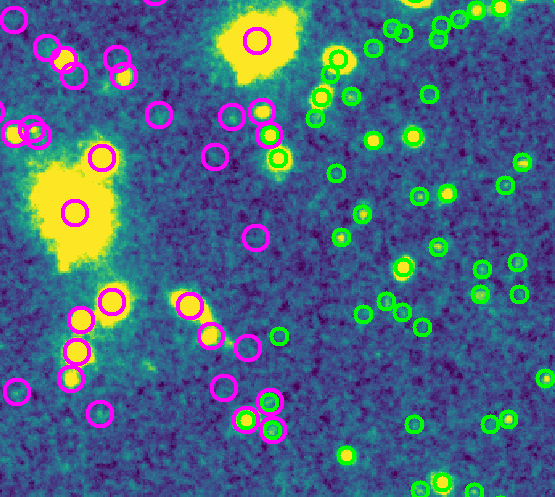
During the DR1 analysis we found that sources at the border between two MER tiles can fall in the inner area of both tiles, see Fig. 15.6, resulting in duplicates in the Euclid’s list of sources. From a statistical point of view, the ratio between duplicates and the whole population of sources in DR1 is . Hence, the presence of duplicates in the dataset do not affect the mission core science.
Inner and outer areas of a tile are defined via Healpix indexes: to check if a source lays within the inner area or not, we convert its RA-Dec position to an healpix index and we check weather that index is part of the inner tile area or not. In DR1, this selection is not strictly done on the position of each object, but on the the position of every object parent cluster, i.e. the pixel cluster before the deblending procedure. Duplicates can be classified in three different subsamples, in terms of if the duplicated sources is blended (DEBLENDED_FLAG = 1) or not (DEBLENDED_FLAG = 0) in the tile where it is detected:
-
•
DEBLENDED_FLAG = 0 in both tiles;
-
•
DEBLENDED_FLAG = 1 in both tiles;
-
•
DEBLENDED_FLAG = 0 in one tile and DEBLENDED_FLAG = 1 on the other one.
For the DR2 processing, we have a proposed solution for the majority of those cases, namely cases where the duplicates source is blended (DEBLENDED_FLAG = 1) in at least one of the tiles. Given how the selection is performed, moving to a strict per object selection removes duplicates related to blended objects. Cases where the duplicated sources has DEBLENDED_FLAG = 0 in both tiles are harder to remove.